A standardised workshop kit housing designed and built by a team of IPO (Industrial Product Design) students.
Categories
 Cities of Things
A standardised workshop kit housing designed and built by a team of IPO (Industrial Product Design) students.
This post is written in Dutch. Below is an English translation added.
Afgelopen Koningsdag hebben we een nieuw experiment gedaan met de Wijkbot, de prototype-kit van een stadsrobot waarmee we in de Afrikaanderwijk aan de slag zijn. Na afloop van het bezoek van de koning organiseerde de wijk een festival in het park. Met de wijkbot was een zogenaamde Verzamelbot gemaakt die hielp het festivalterrein schoon te houden. Het ontwerp en maken van deze Verzamelbot was gedaan door de bewoners van de denktank Cities of Things Lab 010.
On King’s Day we conducted a new experiment with the Wijkbot in the Afrikaanderwijk. After the King’s visit, the neighbourhood organised a festival in the park.
Using the Wijkbot, a Verzamelbot (Collection Robot) was built to help keep the festival grounds clean. The design and construction was carried out by residents of the Cities of Things Lab 010 think tank.
The goal is to explore whether new technology — normally developed by large tech companies — can instead be designed by citizens, with maximum freedom to determine its function. That is the Wijkbot: a robot kit made from simple materials.
After several sessions discussing the role of robots in the neighbourhood, the group decided to seize King’s Day as an opportunity to sketch and test a robot in the neighbourhood. In two brainstorming sessions the Verzamelbot was born, then built at a making workshop at Scrap, using an IBC container as base. The robot was given the function of collecting reusable waste, and also collecting and spreading stories from the neighbourhood.
It was a success: residents at the festival understood the function and sometimes made use of it. The ultimate ideal is that such a kit can be used by residents to develop and operate their own services.
At the Smart & Social Fest, neighborhood robots were used as the basis for two workshops: a walk with 20 people and 1 Wijkbot from CMI op Zuid to the Afrikaanderplein, and a session at Stadslab where quick prototypes were built.
Workshop: Walk with the Neighborhood Robot
Small autonomous vehicles — delivery robots, robot assistants, autonomous rubbish trucks — are increasingly appearing in Rotterdam and are likely to become commonplace within a few years. Will they transform our neighbourhoods into a sci-fi reality, or be adapted to fit the human scale of our communities?
Friday 21 April, we will discuss the progress of the Wijkbot project in a workshop at Smart & Social Fest, organised by the Rotterdam University of Applied Sciences.
Next to the discussion workshop, it is possible to use the Wijkbot kit to create an urban robot!
On Smart & Social Fest: https://www.hogeschoolrotterdam.nl/go/social-fest

With Cities of Things, we look at intelligent (behaviour of) things in our future cities. Robotics combined with an intelligence agency. Last week I attended a lecture by James Bridle, who wrote a book last year on other intelligence last year (Ways of Being), that I liked a lot. They showed how there is more than human intelligence and how these can inspire us. Bridle also made a link to how computing is designed still around the Turing machine. There is another concept that Turing once hinted at in a footnote (1) in his first paper on the automated machine, and later a bit more in the 50s in another paper, but never was able to flesh out. In short, the difference in computing concepts is the way it computes intelligence. The Turing machine uses as much of the existing information and generates the intelligence internally in the system. The Oracle machine is using the art of making theses and the learnings from responses to build intelligence, a machine that is looking outside itself to build knowledge. The lecture by Bridle will be online sometime soon I expect, but he explained the concept in earlier lectures like this one.
Last week Noam Chomsky wrote an opinion piece in The York Times on why ChatGPT offers a false promise (2). I see links here, and interesting enough, the thesis of Chomsky is built upon the notion that current machine intelligence is based on a limited form of computing. At the same time, you could make a case that the form of accessing this machine intelligence via the chat-routine is testing the promise of the oracle machine. On the verge of the introduction of GPT-4 it is useful to think about what we can learn from the application of GPT-3 in the world through these new interfaces, and what we need for the next iteration.
What is missing in the current models is an ability to learn, and to reference a general mental model of the world. If we are using the current tooling right, we make sure that these models (morality) are provided by the human in the loop. We need to be sure there is a human in the loop in using the tooling. And to be sure, having a human in the loop is not the same as a human using machine intelligence to provide answers to questions formulated by humans. It is definitely true that asking the right questions is key, and that is why prompt engineering is such a highly valued expertise in the near future. The example in the article of Chomsky is a speaking example.
The design of these tooling should facilitate, or even more maybe steer, the right flow of theses and claims. The human actor should always create a moral framework before the machine is asked to ‘oracle’ based on general knowledge, and the final judgement is also to the human. In the most sophisticated versions of this tooling, the AI can help to formulate the best claims. I wrote earlier on the concept of co-performance which provides some insightful poses. A useful metaphor is also the centaur, the half-human, half-machine; that is what we are developing more quickly than we might have expected. The most important challenge is to balance the right tasks for the machine and the human.
The image and reference that Bridle uses from the Cybernetic Factory by Stafford Beer (1959) is a possible implementation design. The goal was to create a better way of automating factory processes by using all kinds of outside knowledge and building a complete ecosystem. Bridle connect it to learning from other intelligence like how slime moulds can solve the traveller problem much more efficiently than our current computers can do.
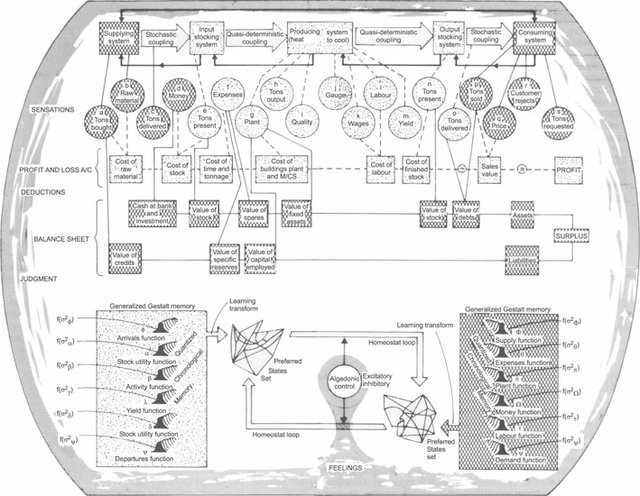
What was not discussed is the relation of the current interaction model within tools like ChatGPT and the possibility of building a kind of Oracle Machine. It feels almost too simple to connect these; what if we can use the power of the dialogues with intelligence in a real learning environment, and what if the outcome is a new form of ecosystem computing? The biggest learning from the upheaval around the use of ChatGPT for all is that we should take into account what the value of the knowledge is. If we can build in the right human guardrails in the oracle machine we might be able to loosen up the limitations of current implementations.
Notes
(1) “We shall not go any further into the nature of this oracle apart from saying that it cannot be a machine” Alan Turing, Systems of Logic Based on Ordinals (1939)
(2) The oped of Chomsky has triggered a debate, Gary Marcus is reflecting on this debate here.
(This post was published earlier via the Cities of Things newsletter)
This update was sent earlier in a slightly different form (and in Dutch) to the partners and participants in the LAB010 project. Read more on the backgrounds of this Cities of Things field lab project here.
The Cities of Things Lab010 project has been running for a year now since its kick-off on February 16, 2022 at Gemaal op Zuid. It has been a busy year for everyone, and also for our project. In this update, I’d like to bring you up to date on the progress and plans for the rest of the project.
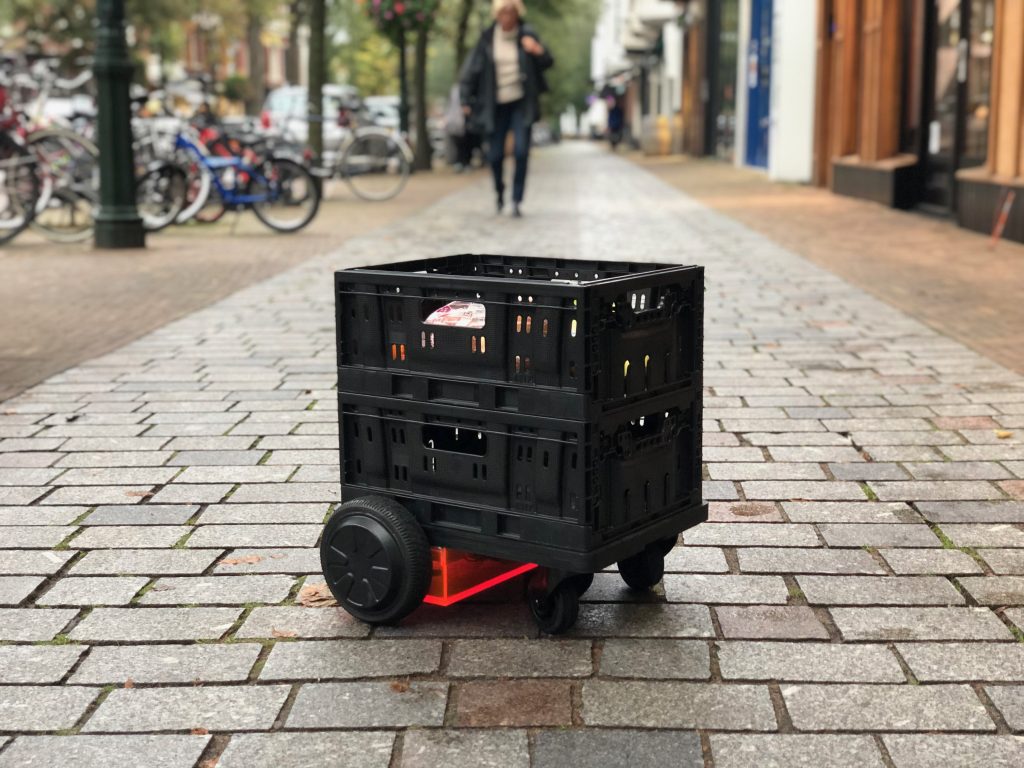
A second group of Technical Informatics students developed a version of the Wijkbot that can navigate autonomously from point to point using sensors and positioning technology, while avoiding obstacles.
The Wijkbot was also present at the ThingsCon unconference on 9 December 2022. Using the basic kit, visitors spontaneously created interventions — including in the café of the conference venue, the Nieuwe Instituut.
The plan is for the Inzamelbot to collect leftover materials at the Afrikaandermarkt. We tested with a version of the Wijkbot carrying a stack of bread crates to see how market visitors respond.
Market visitors don’t bat an eye, and several engage with it. Even without any signage, the function is understood and used.
The reactions were captured with a 360-degree camera and studied afterwards.