Categories
update

Oberbot – Student Project

A group of Technical Informatics students worked on a first technical assignment for the Wijkbot: a self-driving version equipped with sensors to understand its surroundings. The group named their version Oberbot.

The assignment began with studying the existing neighborhood robot and choosing which scenarios to investigate. The scenario explores what it would mean for the Wijkbot to navigate independently.

After choosing the scenario, participants did a brief exploration of available possibilities and components that could be applied.

Categories
update

Workshop at ThingsCon Summer Event

Under the name The Agency of Smart Urban Things, Wijkbot was present at ThingsCon 2022 Summer Edition on 9 June 2022. During the workshop, the Wijkbot went shopping at an Albert Heijn supermarket near the conference venue.

As part of the Cities of Things Lab010 project, we explore urban smart-things: plausible, autonomously operating agents intended to roam the public spaces of the future Rotterdam.

Participants confronted the prototype with citizens in Rotterdam’s public spaces and collectively reflected on the necessary forms of public debate around the role of AI in cities.

Categories
field lab MUC-AMS update

Workshop at MCBW in Munich

Cities of Things will organize a workshop during the yearly Munich Creative Business Week (MCBW) on 16 May 2022 (13:30 – 15:30 at MunichUrbanColab).

Categories
field lab MUC-AMS update

MUC-AMS Amsterdam workshop

Last 23 March we organized a workshop at the Marineterrein in Amsterdam to discuss the progress of the field lab plans and connect with existing and new contacts. The session was a step towards the planning of a field lab program – hopefully – later this year.

We had a good group of people in the hybrid workshop, both from Amsterdam and Munich (and Berlin). We first updated the attendees with the latest developments. Four agencies of the starting consortium have been developing the first conceptualization for the neighborhood hub we now call Collect|Connect Community Hub. Focus is a ‘commoning buffer’ that plays an active role in the neighborhood community life. From the people for the people.

Categories
reflections

blog – Balancing act of sharing agency with the intelligent things

Dear readers. The last edition was just released after the war in Ukraine started. The flow of the war is maybe different than expected in some parts, like the resistance and duration. On the other hand, patterns seem the same as earlier wars initiated by Putin, and also compared to the rituals of growing dictatorships. Some are predicting a long-lasting fight for dominance by democratic systems or dictatorial systems. We only can hope that France will not vote for a extremist new president in two weeks…

How does this all relate to the topic of this newsletter? I made the connection when thinking about one of the key elements of the explorations in Cities of Things: the agency balance. We see that part of our own agency is delegated to the intelligent systems, and that there is a shift happening toward technology as a partner above being a tool. A silent partner though, it is not always visible what is defining the help we get. There is a danger in that, linking it back to the balance between centralized and decentralized systems, between democratic and dictatorial systems. Even if we can resist that shift and if the war is not coming to our own country, we can expect more centralized ruled systems, as part of a warlike state of being. And in the end we are integrated in a geopolitical ecosystem that is already balancing value systems.

Categories
field lab Cities of Things Lab010 update

Social citythings in the IoTRotterdam hackathon

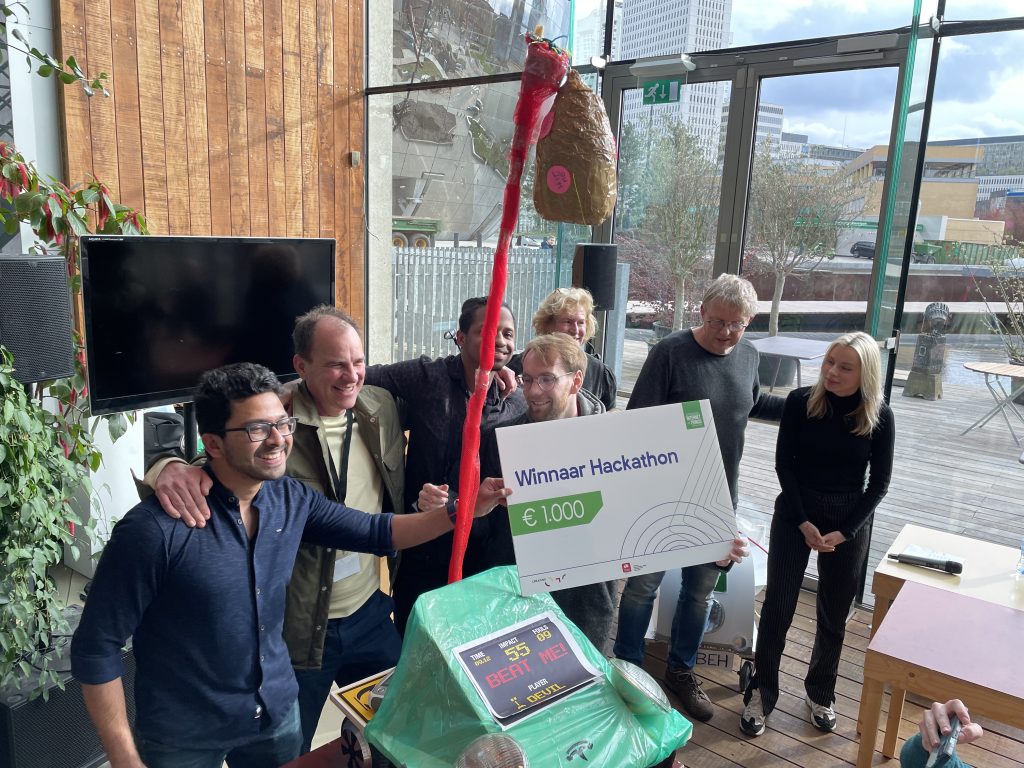
As announced in the latter post the field lab Cities of Things Lab010 was invited to organize the hackathon together with Creating010 and Civic Prototyping Lectorate of this year’s IoTRotterdam event. In the end, four teams participated and build some very nice citythings; autonomous moving objects on the streets of our near-future cities. The goal of the citythings was not defined and part of the process of the teams. Great to see it turned out most of the teams made the decision to let the citythings take a social role in the city life.

The winning team and the judges
Categories
update

Hackathon Report: Social Citythings at IoTRotterdam

As announced in the previous post, Cities of Things Lab010 was invited — together with Creating010 and the Civic Prototyping Lectorate — to organise the hackathon at the IoTRotterdam event.

The winning team presented their project Kickbots: after rapid street research to define their strategy, they designed an urban element that acts as an early-stage intervention against unrest on the street.

Categories
update

Hackathon IoT Rotterdam

At the 10th edition of the IoT Rotterdam event on 8 April 2022, organised by Creating010 at Rotterdam University of Applied Sciences, Cities of Things was one of the hackathon organisers. The prototype used was the original version of what later became the Wijkbot.

In the hackathon, teams quickly conceptualised and prototyped an urban smart-thing: a plausible, autonomously operating agent that would move through the public spaces of the future neighbourhood.

Participants confronted the prototype with citizens in Rotterdam’s public spaces and collectively reflected on the necessary forms of debate around the role of AI in cities.

Categories
field lab Cities of Things Lab010 update

Hackathon IoT Rotterdam

At the 10th edition of the IoT Rotterdam event on 8 April 2022, organized by Creating010 of Rotterdam University of Applied Sciences, Cities of Things will be one of the organizers of the hackathon. More than even hacking, prototyping “urban smart-things” as a different name for citythings will be key. And these prototypes will be tested on the streets of Rotterdam by the teams.

In the hackathon teams of participants will rapidly conceptualize and prototype an “urban smart-thing”: a plausible, autonomously operating agent envisioned to roam the public spaces of the near-future Rotterdam. The participants will confront the prototype with the citizens of Rotterdam in the public areas of the city, interview them and jointly reflect on the necessary forms and shapes of the public debate around the role of AI in cities.

The prototype will use a pre-made “wizard-of-oz” platform, allowing a human operator to remotely simulate an AI algorithm, and control the movement of the prototype. Examples of possible prototypes include, but are (by far) not limited to a mobile garbage bin, interactive street signage, or a mobile plant.

See this movie to get an impression:

The teams will work at the new VONK Innovation Center located just off Coolsingel in Timmerhuis. The results of the explorations will be presented end of the day at Het Nieuwe Instituut where the conference program of IoT Rotterdam is located.

Find more information on the website of IoT Rotterdam, and if you read this on time, please join us!

preparing the wizard-of-oz platforms

The hackathon is part of the activities of Cities of Thing Lab010 field lab. We keep you posted on the results!

Background

AI is increasingly used in cities to improve their efficiency, as part of urban services and infrastructure, but is also being embedded in various kinds of soon-to-be-autonomously operating agents. Autonomous passenger cars are only one example of such use of AI that will become commonplace within the coming decade. There will also be autonomous garbage collection vehicles, safety, and traffic monitoring agents, advertising and informational bots, delivery vehicles, and many more… As citizens we still rarely think about the impact that such autonomous AI agents will have on our everyday life, beyond the advertised improvement of everyday conveniences, such as the comfort of care-free riding in a self-driving car, or receiving fast online deliveries. Autonomous AI agents will soon, however, impact almost every aspect of our lives, for example

  • will share the public space with us on every step, 
  • will take over automatable jobs (chauffeurs, vendors, cleaners),
  • will be used to monitor us and enforce rules and laws (street signage and access control).

We can’t fully predict what the impact of autonomous AI agents will be on our society and cities, but we can try to collectively envision, understand and democratically shape the applications of this future technology so that it serves our society to the best possible extent. However, as non-expert citizens, we lack first-hand experiences with autonomous agents in the everyday-life setting, which we could use as a point of reference for debate and contestation of AI-related developments.

Categories
update

Update activities Cities of Things

Spring officially began. A good moment to share some of the activities of Cities of Things in the last months. I write a monthly update and reflection via this email newsletter you can subscribe to.

The two biggest programs at this moment are the field labs in Rotterdam as part of the CityLab010 program, and the field lab as part of Creative Embassy Munich-Amsterdam.

City of Things Lab010

We had the official kick-off with the consortium parties in February and we did start the research activities with a graduation student looking into the design for the Cities of Things design toolkit, and a team of Technical Information students that will work on a prototype of a citything that can be used in the further explorations in the neighborhoods.

We also will organize the hackathon of the IoT Rotterdam program on 8 April with the same prototype as a basis. The first wizard-of-oz version of the prototype was made by Tomasz Jaskiewicz.

MUC-AMS Cities of Things field lab

As reported here before we signed the Letter of Intent in October in Munich. Four of the Dutch consortium partners started to develop a possible field lab research program: a logistic neighborhood hub that will be designed for the neighborhood. Springtime, Space&Matter, Sophisti, and INFO are working towards the first concept to present to possible partners in both Amsterdam and Munich.

Coming 23 March a hybrid session will be organized at the Marineterrein Amsterdam to meet partners, both from Amsterdam and Munich, to update the program plans and discuss the hub concept. If you like to join, contact Iskander.

16 May we will travel to Munich again to participate in the Munich Creative Business Week with a workshop dedicated to the same goal; connecting the right partners for making the field lab project happen.

Other activities

Next to these more activities are starting or in the planning.

  • Together with Advier we are looking into a research program for Living as as Service in Cities of Things.
  • We plan to partner more with Responsible AI group of Amsterdam University of Applied Sciences. We commissioned a assignement for prototyping natural interactions with vocal citythings in the Applied AI minor.
  • Cities of Things is part of two RAAK research proposals by AUAS.
  • We organized a workshop at Mozfest March 11 with a presentation by Maria Luce Lupetti.
  • Iskander was invited to