Categories
update

Meet the Wijkbot!

Welcome! Whether you’ve encountered the Wijkbot in person or heard about it, read on for an introduction to how the Wijkbot came about and its journey so far.

On this website you’ll find many examples of neighborhood robots built in workshops, in the Cities of Things LAB010 living lab, in student projects, and at festivals. Contact Iskander if you’d like to know more or would like us to organise a workshop.

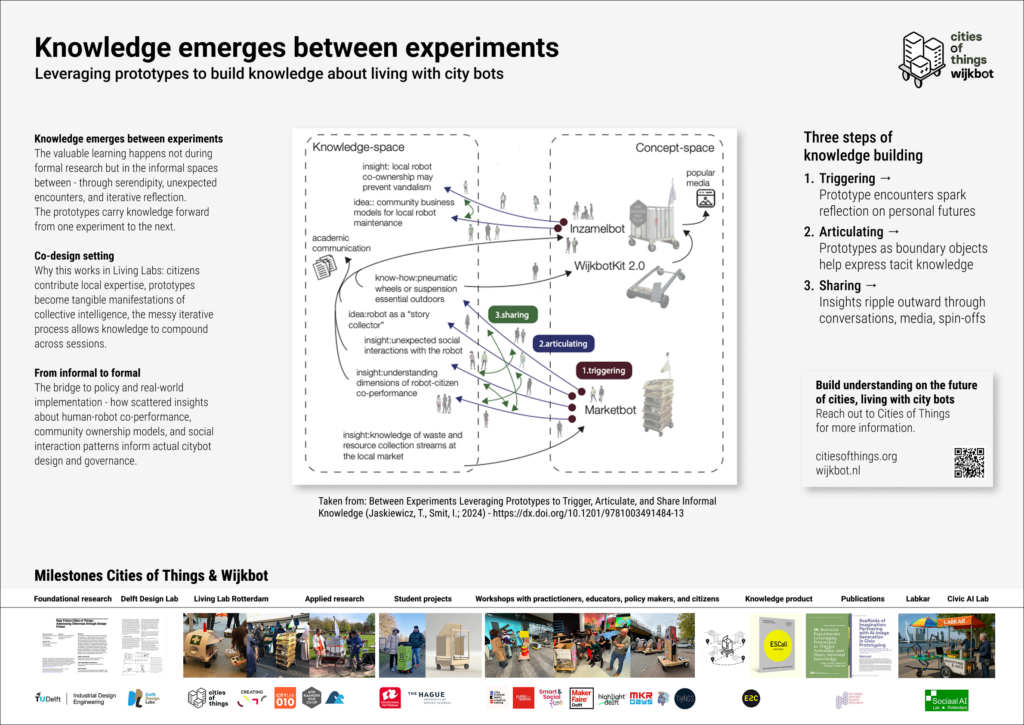
The Wijkbot began as an accessible way for anyone to quickly prototype city robots. In the Cities of Things LAB010 project (2022–2024), we collaborated with the Afrikaander Cooperative and spent a year working with a residents’ think tank to explore what city robots could mean for the Afrikaanderwijk. The result was the Inzamelbot — a collection robot.

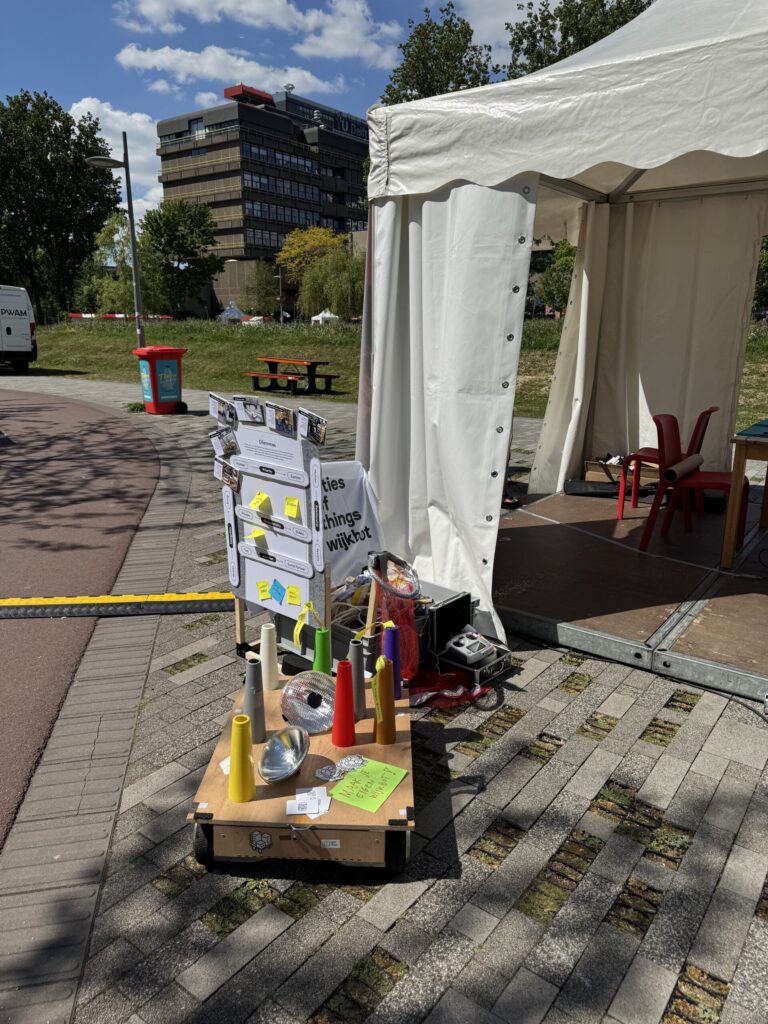
The Inzamelbot’s appearance was inspired by the newly opened Grondstoffenstation of the Cooperative. The Wijkbot platform today combines a second-hand hoverboard as a base with a standard open-source controller, and a body built from leftover packaging materials from the nearby market.

We’ve discovered that the Wijkbot platform is an excellent way to start conversations, generate knowledge, and make tangible what would otherwise remain abstract. We’ve experienced this in workshops at PublicSpaces (Amsterdam), the Society 5.0 Festival, Smart & Social Fest (Rotterdam), Climate Meets Creative Coding (Hamburg), Dutch Design Week, and many others.

Over the past years, many student projects have been carried out using the Wijkbot platform as a foundation or tool — conceptually, design-focused, and technically.

The Wijkbot is an initiative of Cities of Things and Creating010. Cities of Things is a knowledge platform and research programme that originated at TU Delft, focused on the design of intelligent things and their role in cities and society.
Categories
update

Wijkbots in the wild at two events

This week, Wijkbot is present in different forms at two events, one in Amsterdam and one in Delft.

ESConference, Amsterdam, 11-13 February 2026

The Wijkbot Kit 2.0 is part of the ESC conference exhibition, the annual conference of the Expertisenetwork Systemic Co-Design*, held 11-13 February at Pakhuis de Zwijger, Amsterdam. Wijkbot has received funding from the ESCall program to refine its existing knowledge product, the Wijkbot Kit. In that project, we expanded the workshop to place greater emphasis on the contextual aspects and second-order effects of introducing wijkbots in existing neighborhoods or communities. We’ve written about this project previously.

Highlight Festival, Delft, 11-14 February 2026

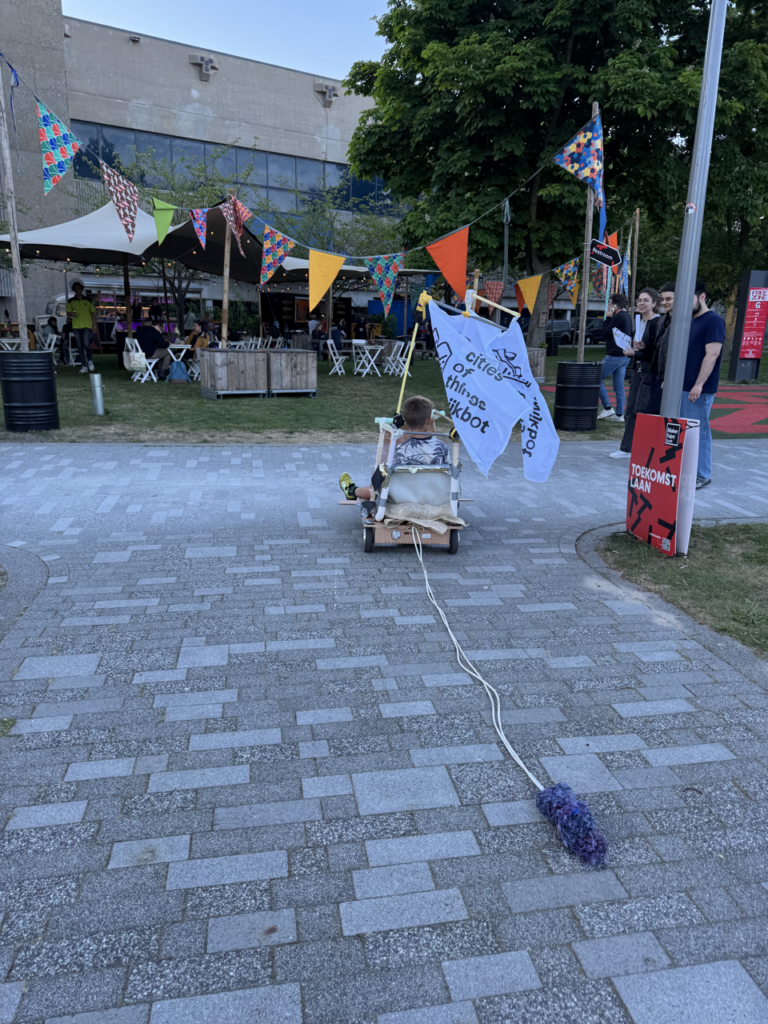
The Highlight Festival** in Delft (11-14 February) is themed “Robo-futures” this year—a fitting context for the Labkar, a mobile robot derived from the Wijkbot concept and developed as part of the Sociaal AI Lab in Rotterdam by Creating010 (Hogeschool Rotterdam). It will be around in Delft at Leeuwenhoek park and in case of bad weather in The Social Hub, both next to NS Station Delft.

We invite visitors to consider what roles a neighborhood robot might play on the streets of Delft.

Hoodbots (Wijkbots) are experimental urban robots developed within the Civic Prototyping research group at the Research Centre Creating010 (Rotterdam University of Applied Sciences). These AI-speaking vehicles roam public space to spark unexpected encounters and ask big questions: Who owns robots in our streets? Who takes care of them? And how do we want to live alongside them?


*The Expertisenetwork Systemic Co-design (ESC) connects four metropolitan universities of applied sciences, six design research groups, and 38 societal and design partners. As a leader in systemic and design-oriented work, ESC has a direct and indirect impact at the intersection of practice-oriented design research, design professionalization, societal transitions, and education.

**Now in its ninth year, Highlight Festival transforms Delft into a playground for art and technology. Each edition brings together artists, designers, engineers, and researchers to create site-specific installations across the city. From light and sound to robotics and data, and research and fine art, the festival invites visitors to explore innovation and creativity in unexpected ways, not just as spectators, but as active participants in shaping the future.

Categories
update

Wijkbot in the ESC Book

How do you collaboratively and creatively work towards systems change? And how can you share, deepen and scale the knowledge that emerges from this?

In this publication, designers and creative agencies from our network share their knowledge products: card sets, games and prototypes that emerged from design practice in transition contexts. Rich in practice stories, methods and reflections — covering themes such as justice, polarisation, democratisation, reciprocity, synergy, expression and reflection.

The Wijkbot is also included in the booklet.

Download the booklet via ESC or below.

Categories
update

Wijkbot at Maker Faire Delft

On 9 May, the Wijkbot was once again at Maker Faire Delft, this time as a guest at Stadslab Rotterdam. In addition to a WijkbotKit, the platform was used for a first demo version of a Lab Cart — a way to bring makerspaces into the neighbourhood.

A new Maker Faire Delft was organised on the TU Delft campus. Makers from technology, art, fashion and crafts showed how creativity contributes to a more sustainable world, with presentations, demonstrations and workshops for all ages. Sustainability and fashion were central themes, with upcycling and vintage inspiration.

Stadslab Rotterdam organised various demonstrations and had invited Wijkbot to attend. A first version of a new project — the Labkar — was showcased: how can a lab cart bring the makerspace into the neighbourhood?

Categories
update

Wijkbot in the Publiekwijs Handbook

The Wijkbot has been included in the Publiekwijs Handbook. The book is the result of experimental innovative research within the Incubator programme of the Stimuleringsfonds voor de Journalistiek (Dutch Journalism Fund).

For Dutch media newsrooms — and local private media in particular — reconnecting with the lived experience of their audience is increasingly important, partly due to the rapidly changing media landscape. This handbook helps with that.

See the page and illustration below. Thanks to Josje Kerkhoven for including Wijkbot, and Charis Stephanie for the lovely illustration.