Categories
update

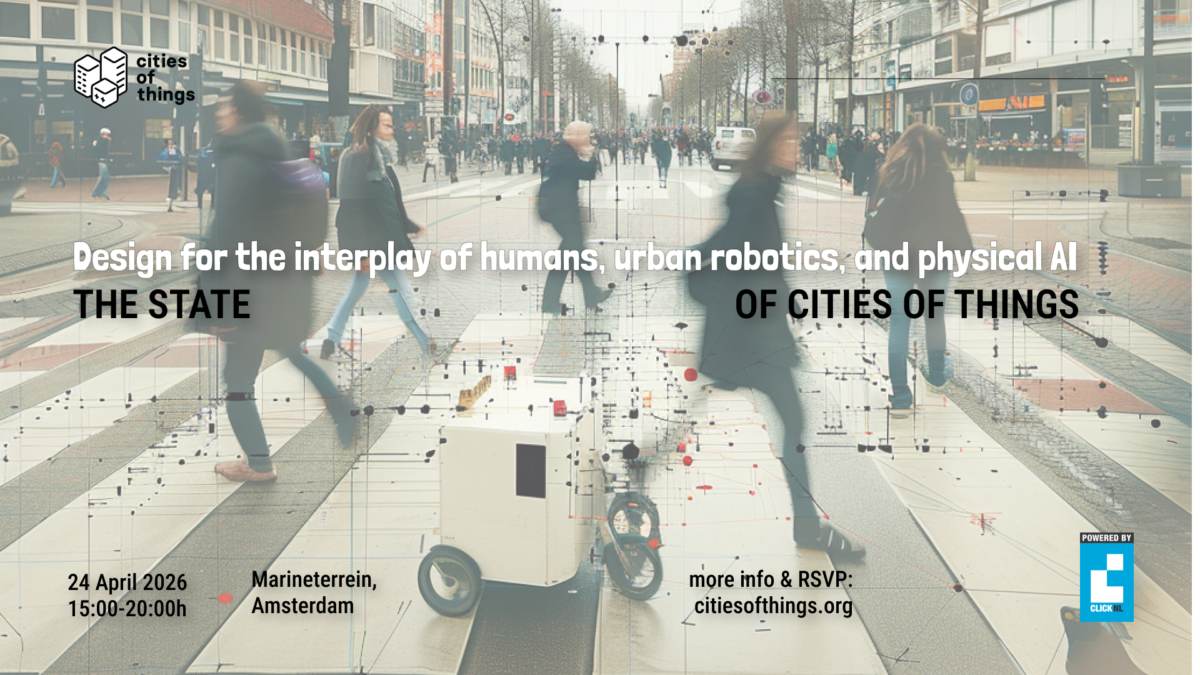
Join us: State of Cities of Things event 24 April

State of Cities of Things: design for the interplay of humans, urban robotics, and physical AI

Last November, it was 7 years after the launching paper was presented at NordiCHI, “Near future cities of things: addressing dilemmas through design fiction“. It made me think it would be nice to reflect on the last seven years, especially on the state of Cities of Things, with the people who were important during those years. So I started planning interviews. In the coming month, this will come together in a publication, and I would like to invite you to join us for a network event where we present the results and reflect on them with some special guests. Powered by CLICKNL.

SAVE THE DATE:
Friday, 24 April 2026, in the afternoon.
Location in Amsterdam.
With: Iskander Smit, Maria Luce Lupetti, Sen Lin, Tomasz Jaskiewicz, and Vera van der Burg. Moderated by Monique van Dusseldorp.

Program

The program for the event:

15:00h__Doors open
__Wijkbot/Hoodbots will be present to explore!
16:00h__Welcome and introduction
__Presenting the research results by Iskander Smit
16:30h__Panel introductions
__Maria Luce Lupetti, Sen Lin, Tomasz Jaskiewicz, Vera van der Burg
17:00h__Interactive reflections
__Panel and participants moderated by Monique van Dusseldorp
18:00h__Drinks and bites
20:00h__End

About the panel

Maria Luce Lupetti is an Assistant Professor in Design at the Department of Architecture and Design at Politecnico di Torino. Her research is concerned with all matters of human entanglement with the artificial world, especially concerning complex technologies such as AI and robotics. She is co-director of POEL – Possible Entanglements Lab, a research group dedicated to investigating how people and technologies co-shape one another, and how design can help envision desirable configurations.

She is the PI of ‘Participatory Design Justice for Ethical AI Transitions’, a three-year project funded by the Italian Ministry of Education and Research, under the FIS2 program. She is also Partner Investigator at the ARC Centre of Excellence for Quality Work in the Digital Age, and serves as Exhibit X section editor for ACM Interactions Mag.

Maria Luce Lupetti was a postdoc researcher at the start of the Cities of Things research program at Delft University of Technology, and author of the first paper on the topic.

Sen Lin was among the first master graduate students at Delft Design Lab Cities of Things, with his research “Hinting Civic Futures, A call for cityness in the future smart age“. In 2024, Sen developed with Iskander the speculative workshop for Generative Things, as part of the ThingsCon team.

Sen is a product designer and researcher keen on design reflection and value intervention. Possessing a diverse background in strategic design, design speculation, and innovation consulting, he is passionate about creating socio-technical apparatuses following his importance felt. Sen used to lead trend-driven innovation and design foresight at Thoughtworks China, uncovering strategic pivots to future-proof businesses.

After working in China for 5 years, he returned to the Netherlands in 2023. He has been visiting China for a couple of months beginning 2026 and Sen will share his impressions from urban robotics in the China of today.

Tomasz Jaskiewicz is a professor in Civic Prototyping at the Creating010 knowledge centre at Rotterdam University of Applied Sciences. Within his research group, he investigates new applications, methodologies, tools and processes to engage city dwellers in digital innovation within their social and physical living environments.

Tomasz has been active within the Creating010 Research Centre since 1 March 2021. Tomasz Jaskiewicz has a background in architecture and urban planning and has practical work experience developing experimental architecture projects, interactive installations, and digital design tools. Since 2014, he has worked as an assistant professor at the Faculty of Industrial Design Engineering at TU Delft, where he has focused his research on Explorative Prototyping as a strategy for dealing with the complexity inherent in designing interactive environments. In parallel, he has also conducted substantive research into social practices within flexible office ecosystems and ‘smart’ urban contexts.

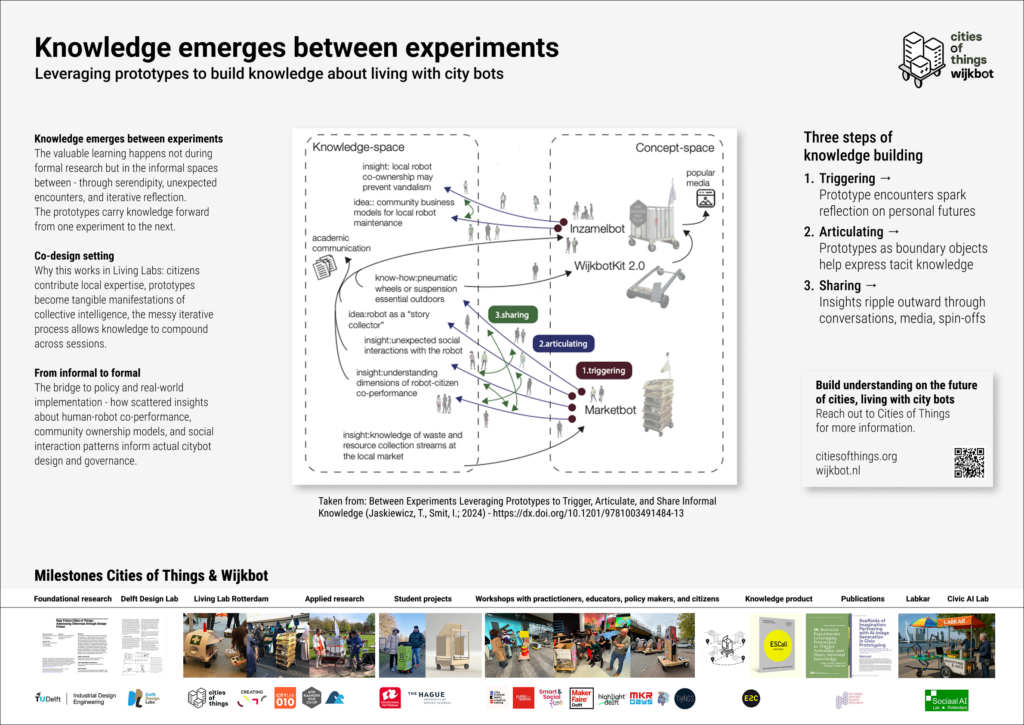
Tomasz was an initiating partner in the Cities of Things LAB010 living lab, and developed the first Wijkbot concept for civic prototyping citybots. He will share, among others, the backgrounds of Wijkbot/Hoodbot and the learnings ‘Between Experiments’ (ref).

Vera van der Burg is a designer, researcher, and Ph.D. candidate at TU Delft’s Designing Intelligence Lab, where she develops Reflective AI: a design practice that treats artificial intelligence as material for creative reflection rather than a tool for automation.

Her research investigates how training AI models can become a reflective practice, how subjective datasets reveal our own perspectives back to us, and how we might use AI to examine ourselves rather than extract from others. Vera strives to develop slower, smaller, and more intimate approaches to working with AI in creative practices, and I combine working with AI tools with an active making practice.

With her project Text-to-Clay, she showed at the last Dutch Design Week a different relationship with AI for design. She was awarded Emerging Talent at the Dutch Design Awards and FD Talent 50, and was featured in Dezeen.

Location

The event will take place in Commandantszaal at Marineterrein, Amsterdam

Registration

Please let us know if you plan to join! Also, if you only join us part of the time.

About the research

The current list of (planned) interviews for the research: Alain Dujardain, Cristina Zaga, Elisa Giaccardi, Emiel Rijshouwer, Gerard Nijboer, Iohanna Nicenboim, Jann de Waal, Jelmer Koedood, Jip Schelling, Kars Alfrink, Kristel Thieme, Louise Hugen, Marcel Schreuder, Maria Luce Lupetti, Martijn de Waal, Nazli Cila, Paul Geurts, Paul Skinner, Peter van Waart, Ren Yee, Rob van Kranenburg, Sen Lin, Simone Rebaudengo, Thijs Turèl, Tomasz Jaskiewicz, Vera van der Burg, Viktor Bedö

Below is a PDF I made as an introduction for the interviewees.

Categories
update

Meet the Wijkbot!

Welcome! Whether you’ve encountered the Wijkbot in person or heard about it, read on for an introduction to how the Wijkbot came about and its journey so far.

On this website you’ll find many examples of neighborhood robots built in workshops, in the Cities of Things LAB010 living lab, in student projects, and at festivals. Contact Iskander if you’d like to know more or would like us to organise a workshop.

The Wijkbot began as an accessible way for anyone to quickly prototype city robots. In the Cities of Things LAB010 project (2022–2024), we collaborated with the Afrikaander Cooperative and spent a year working with a residents’ think tank to explore what city robots could mean for the Afrikaanderwijk. The result was the Inzamelbot — a collection robot.

The Inzamelbot’s appearance was inspired by the newly opened Grondstoffenstation of the Cooperative. The Wijkbot platform today combines a second-hand hoverboard as a base with a standard open-source controller, and a body built from leftover packaging materials from the nearby market.

We’ve discovered that the Wijkbot platform is an excellent way to start conversations, generate knowledge, and make tangible what would otherwise remain abstract. We’ve experienced this in workshops at PublicSpaces (Amsterdam), the Society 5.0 Festival, Smart & Social Fest (Rotterdam), Climate Meets Creative Coding (Hamburg), Dutch Design Week, and many others.

Over the past years, many student projects have been carried out using the Wijkbot platform as a foundation or tool — conceptually, design-focused, and technically.

The Wijkbot is an initiative of Cities of Things and Creating010. Cities of Things is a knowledge platform and research programme that originated at TU Delft, focused on the design of intelligent things and their role in cities and society.

Categories
update

Wijkbots in the wild at two events

This week, Wijkbot is present in different forms at two events, one in Amsterdam and one in Delft.

ESConference, Amsterdam, 11-13 February 2026

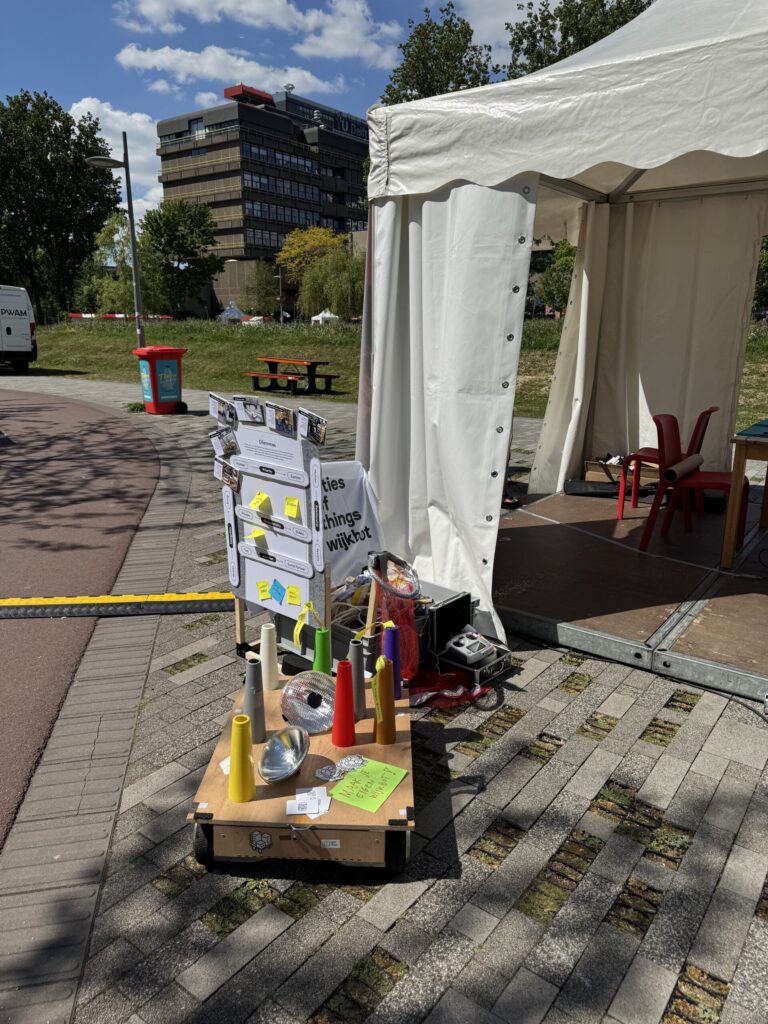
The Wijkbot Kit 2.0 is part of the ESC conference exhibition, the annual conference of the Expertisenetwork Systemic Co-Design*, held 11-13 February at Pakhuis de Zwijger, Amsterdam. Wijkbot has received funding from the ESCall program to refine its existing knowledge product, the Wijkbot Kit. In that project, we expanded the workshop to place greater emphasis on the contextual aspects and second-order effects of introducing wijkbots in existing neighborhoods or communities. We’ve written about this project previously.

Highlight Festival, Delft, 11-14 February 2026

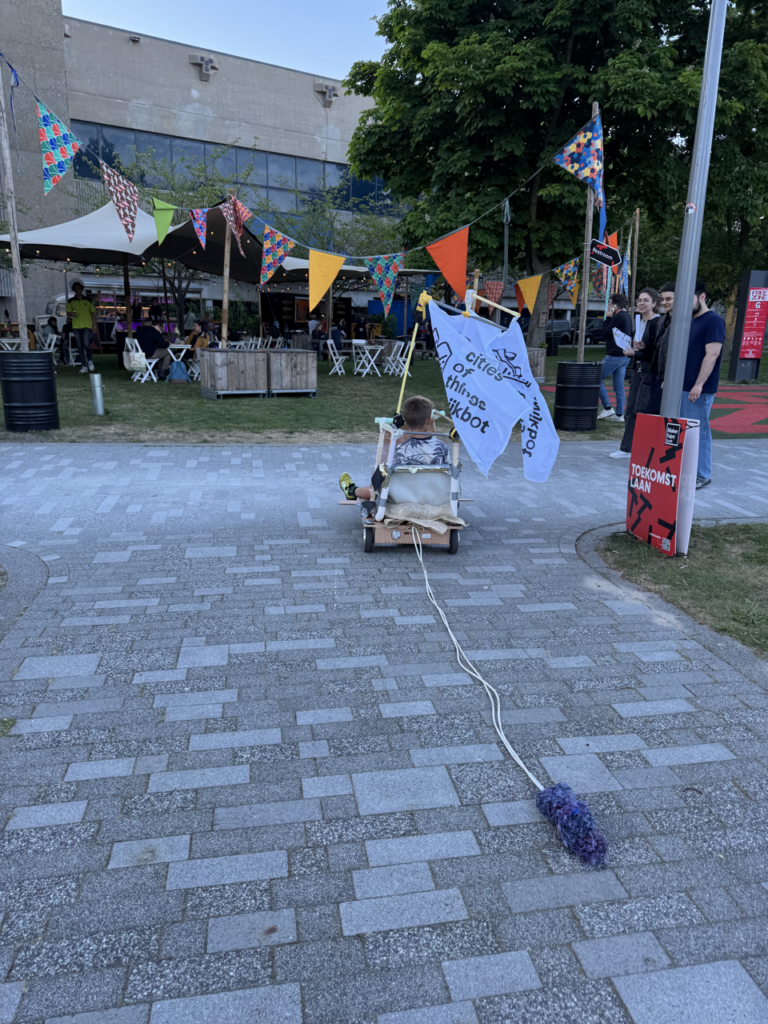
The Highlight Festival** in Delft (11-14 February) is themed “Robo-futures” this year—a fitting context for the Labkar, a mobile robot derived from the Wijkbot concept and developed as part of the Sociaal AI Lab in Rotterdam by Creating010 (Hogeschool Rotterdam). It will be around in Delft at Leeuwenhoek park and in case of bad weather in The Social Hub, both next to NS Station Delft.

We invite visitors to consider what roles a neighborhood robot might play on the streets of Delft.

Hoodbots (Wijkbots) are experimental urban robots developed within the Civic Prototyping research group at the Research Centre Creating010 (Rotterdam University of Applied Sciences). These AI-speaking vehicles roam public space to spark unexpected encounters and ask big questions: Who owns robots in our streets? Who takes care of them? And how do we want to live alongside them?


*The Expertisenetwork Systemic Co-design (ESC) connects four metropolitan universities of applied sciences, six design research groups, and 38 societal and design partners. As a leader in systemic and design-oriented work, ESC has a direct and indirect impact at the intersection of practice-oriented design research, design professionalization, societal transitions, and education.

**Now in its ninth year, Highlight Festival transforms Delft into a playground for art and technology. Each edition brings together artists, designers, engineers, and researchers to create site-specific installations across the city. From light and sound to robotics and data, and research and fine art, the festival invites visitors to explore innovation and creativity in unexpected ways, not just as spectators, but as active participants in shaping the future.

Categories
update

Wijkbot at Makerfaire Eindhoven

At MakerDays 2025, the MakerFaire in Eindhoven, the Future Parade is a fixed part of the programme on 27 & 28 September 2025. The Wijkbot was part of the parade with a special version of the Gemaal op Zuid Rotterdam project, where children build their own robots from leftover market materials.

Categories
reflections update

Systemic co-design with agentic engineers

Weekly reflection on human-AI-things collaborations

The shift isn’t from human coders to AI agents. It’s from coding to engineering.

Every, the company behind Lex (which I’m using right now), released four predictions for 2026. The one that stuck with me: the rise of the “agentic engineer.” A couple of months ago, I wrote about an Austrian developer Peter Steinberger, who described this exact reality—directing a team of AI agents rather than writing code himself.

But calling this “directing agents” undersells what’s happening. The agentic engineer doesn’t just orchestrate; they design the environment in which agents can work at their best capacity. They build their own tools, shape workflows, and define constraints. The craft moves upstream: from writing the code to engineering the context.

This connects to another of Every’s predictions: designers building their own tools. That was what triggered me in the Austrian developer’s account was how much of his work involved creating bespoke tooling for his own process. This is what happens when the friction between idea and prototype disappears—designers no longer depend on a coder to test their thinking. They build, they learn, they iterate. Two principles at work: Understanding by doing, and Eating your own dogfood.

And here’s where it gets interesting: if professionals are building their own tools, will end users follow? Is every product becoming less an interface to data and more a platform for making bespoke tools? Does a new layer emerge where users shape their own outcomes?

I think this points toward co-design—but a richer version than we usually mean. Not just designer and user collaborating, but multiple layers of expertise are woven into the design process. The economist who maps value flows in a community. The ethicist who flags downstream effects. Stakeholders who traditionally appear only in the research phase are becoming part of the building itself.

In this framing, agents don’t just execute—they can represent these roles, simulate options, play out consequences before anything hits the real world. Agents as citizens. Not tools we use, but participants in how we design.


Within Cities of Things we have been looking into human-AI teams for a masterclass on designing these new teams, where this engineering was a key element. Building successful human-AI teams should focus on the relationships among the different human and non-human team members, not on task performance.


This triggered thought is part of my weekly newsletter:

Weeknotes 371 – The real shift is not from human coders to AI agents—it’s from coding to engineering the environment where agents are co-designers. And other news on AI companion devices and robots at CES.

https://www.iskandr.nl/systemic-co-design-with-agentic-engineers

Image: Interpretation by Midjourney

Categories
update

Agentic AI and the intensifying of immediacy relations

On 17 July, Cities of Things was invited by Catch A Fire Agency to organise, design, and moderate a speculative design workshop for one of their clients on the topic of Agentic AI and its relation to the addiction to immediacy.

The workshop was part of a full-day program for a group of marketing professionals, and the time was limited (1 hour), so the speculative design part could only touch the surface. It worked very well, however, to engage with the thoughts I shared on the topic in an opening presentation. The flow of the session was roughly as follows: a 5-minute welcome, a 15-minute inspirational talk on the topic, a 10-minute introduction to speculative design and scenarios, a 15-minute group-based engagement with the topic through concepting an agentic object in an immediacy situated context, and a 15-minute sharing and recap.

I created a fresh presentation that combines thinking on immersive AI in urban spaces with the culture of immediacy. I introduced a model, the “triad of immersion,” that generates a so-called superstimulus effect by combining agentic AI, the cult of immediacy, and the physical environment as context. This SSE is accelerating the wheel of addiction even more. Based on these insights, I created four scenarios for the hybrid futures. The groups thought of an agentic generative object to make this tangible.

The updated story on things with agency in relation to immedicacy worked out nicely, and resonated with my earlier research on predictive relations.

The use of speculative design, including the application of the Design Fiction Work Kit and LEGO tools to express ideas, proved to structure the workshop and deliver on its output, even though time was too short for fleshed-out prototypes.

I am happy to share more details on request. Email me if you are interested!

Below are a few snippets from the presentation.

Categories
reflections update

June reflections on Cities of Agentic Things

Since this year I update the Substack Cities of Things with a short speculative design exercise. In good current habit, in a back-to-back composing with Claude (via Lex.page): I bring in my thoughts, I create an object concept and Claude is creating a little day-in-the-life story of it, and connects it back to the original thoughts.

You can subscribe to the substack, but I added the story and reflections also below:

Categories
update

Wijkbot in the ESC Book

How do you collaboratively and creatively work towards systems change? And how can you share, deepen and scale the knowledge that emerges from this?

In this publication, designers and creative agencies from our network share their knowledge products: card sets, games and prototypes that emerged from design practice in transition contexts. Rich in practice stories, methods and reflections — covering themes such as justice, polarisation, democratisation, reciprocity, synergy, expression and reflection.

The Wijkbot is also included in the booklet.

Download the booklet via ESC or below.

Categories
update

Wijkbot at Maker Faire Delft

On 9 May, the Wijkbot was once again at Maker Faire Delft, this time as a guest at Stadslab Rotterdam. In addition to a WijkbotKit, the platform was used for a first demo version of a Lab Cart — a way to bring makerspaces into the neighbourhood.

A new Maker Faire Delft was organised on the TU Delft campus. Makers from technology, art, fashion and crafts showed how creativity contributes to a more sustainable world, with presentations, demonstrations and workshops for all ages. Sustainability and fashion were central themes, with upcycling and vintage inspiration.

Stadslab Rotterdam organised various demonstrations and had invited Wijkbot to attend. A first version of a new project — the Labkar — was showcased: how can a lab cart bring the makerspace into the neighbourhood?

Categories
update

Check out the new activities page

Next to our newsletter, organizing knowledge sharing, and commissioning of research projects, we have developed over the last years two specific activities to help understand, and formulate insights and opinions on our future co-living with agentic physical AI in our neighborhoods and cities.

Futuring and Civic Prototyping

Two types of activities to make sense of the future of Cities of Things, agentic things in the city, things as citizens:

– Cities of Things Futuring, a speculative workshop, adapted to context, audience, and knowledge needs. Generative Things, understanding future paths with physical AI.

– Robo-perspectives civic prototyping, generating knowledge and insights, connecting citizens, shaping policies. Using the WijkbotKit to understand the impact of neighborhood robo-things.

Read more on our dedicated page: