Two teams from the IUXD (Interface & User Experience Design) course at Rotterdam University of Applied Sciences designed concepts for the Wijkbot, with the Cool Zuid neighbourhood as their starting point. Both teams had already conducted field research in the neighbourhood.
We gave students this brief: In this assignment, we want to challenge you to think about the form a robot could take to strengthen social cohesion in the neighbourhood. You can develop a concept for a new robot, or redesign an existing Wijkbot.
After conducting research and an extensive ideation process, the teams arrived at two different concepts.
Two student teams from the Next Level Engineering master programme at The Hague University of Applied Sciences presented their final projects on 25 January 2024 at Delft Campus, as part of the Design and Technology course.
We distinguished two goals: one group focused on collecting leftover raw materials for the Grondstoffenstation, while the other focused on a broader market application.
The groups explored the possibilities of the neighborhood robots and conducted research on location and with residents and workers at the market.
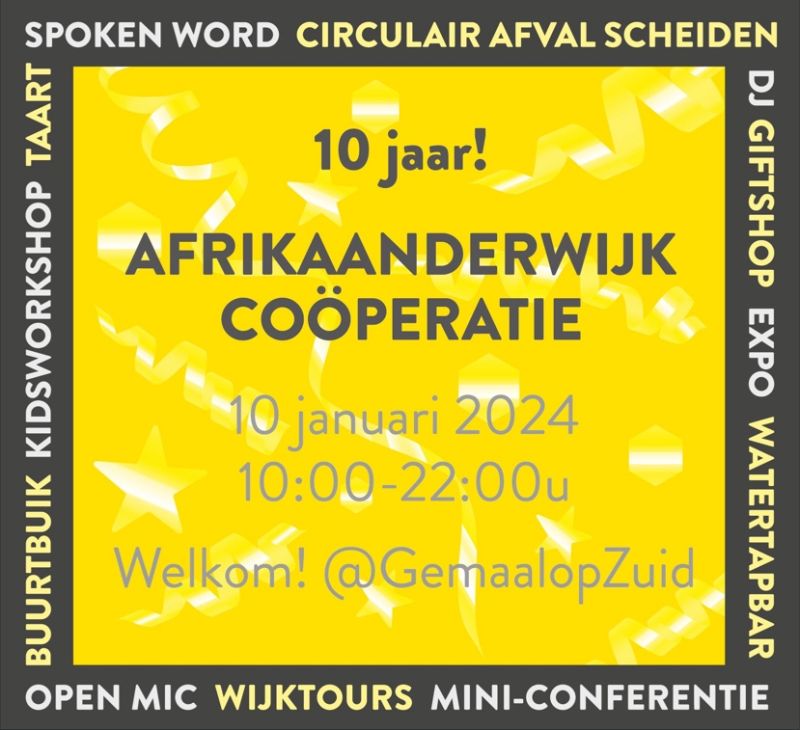
It was a celebration on 10 January: the Afrikaander Cooperative marks its tenth anniversary, and the new Grondstoffenstation is officially opened by alderman Vincent Karremans. The Cooperative was a key partner throughout the Cities of Things LAB010 project.
Throughout the day there were festivities at the Gemaal. As part of the programme, the Cities of Things LAB010 project was showcased with an installation featuring three different Wijkbots — including the Inzamelbot.
During the mini-conference, we briefly presented the project to those present.
The Wijkbots were well represented at TH/NGS 2023, the annual conference on the connected world and responsible design organised by ThingsCon — with a workshop on 15 December and a broader programme on the 16th.
The theme of TH/NGS 2023 was Un/intended consequences: what is the impact of new intelligence, and when is a consequence intended or unintended?
More than 50 participants were divided into 3 groups, each challenged to design an urban robot that serves a city function but also exhibits unintended behaviour.
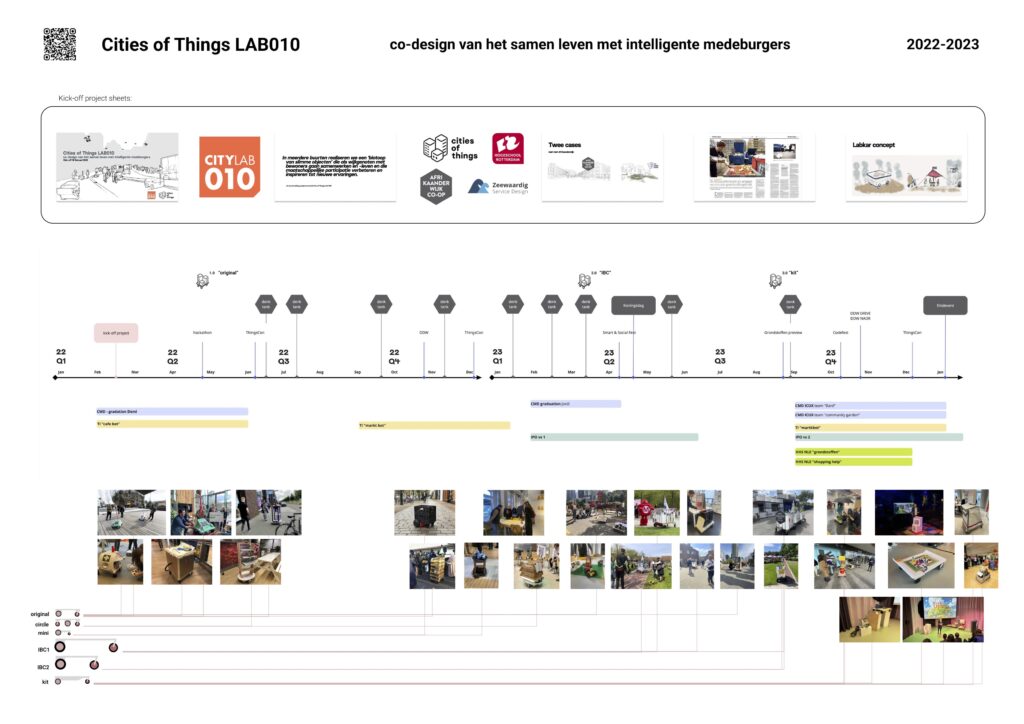
At the beginning of 2022, we officially kicked off the project Cities of Things LAB010, shaped together with Creating010 of Rotterdam University of Applied Sciences and with main partners Afrikaander Wijkcooperatie and Studio voor de Stad (represented by Zeewaardig). To close the two-year project, we will be part of the 10-year celebration of Afrikaander Wijkcooperatie on 10 January at Gemaal op Zuid in Rotterdam. Read more here.
The project’s goal was to create a toolkit for co-designing the future presence of city things in neighbourhoods so that this is driven by the local communities and not by the so-called big tech companies. We have a page dedicated to the fieldlab, find more on the start backgrounds of the project.
This project strives for positive and productive ways of living and working together with citizens with ‘city things’, by designing them together with them, developing competences to organize their lives with ‘smart things’ and thus involving citizens in the design of their own neighborhood in the context of the developing ‘smart city’.
Descriptions Cities of Things LAB010
Early in the project, we developed a basic robot prototype platform based on the combination of a Hoverboard connected to a remote control that powered a platform that makes it possible to experiment with different functions and let you play out interactions of the urban robot with other things and especially people. In a hackathon in April 2022, we tested the platform as a basis for new ideas and civic prototyping, which turned out to work very well. Since then, the kit has been functioning as a platform for both technical explorations (adding sensors and autonomous behaviour) and design exercises for different functions.
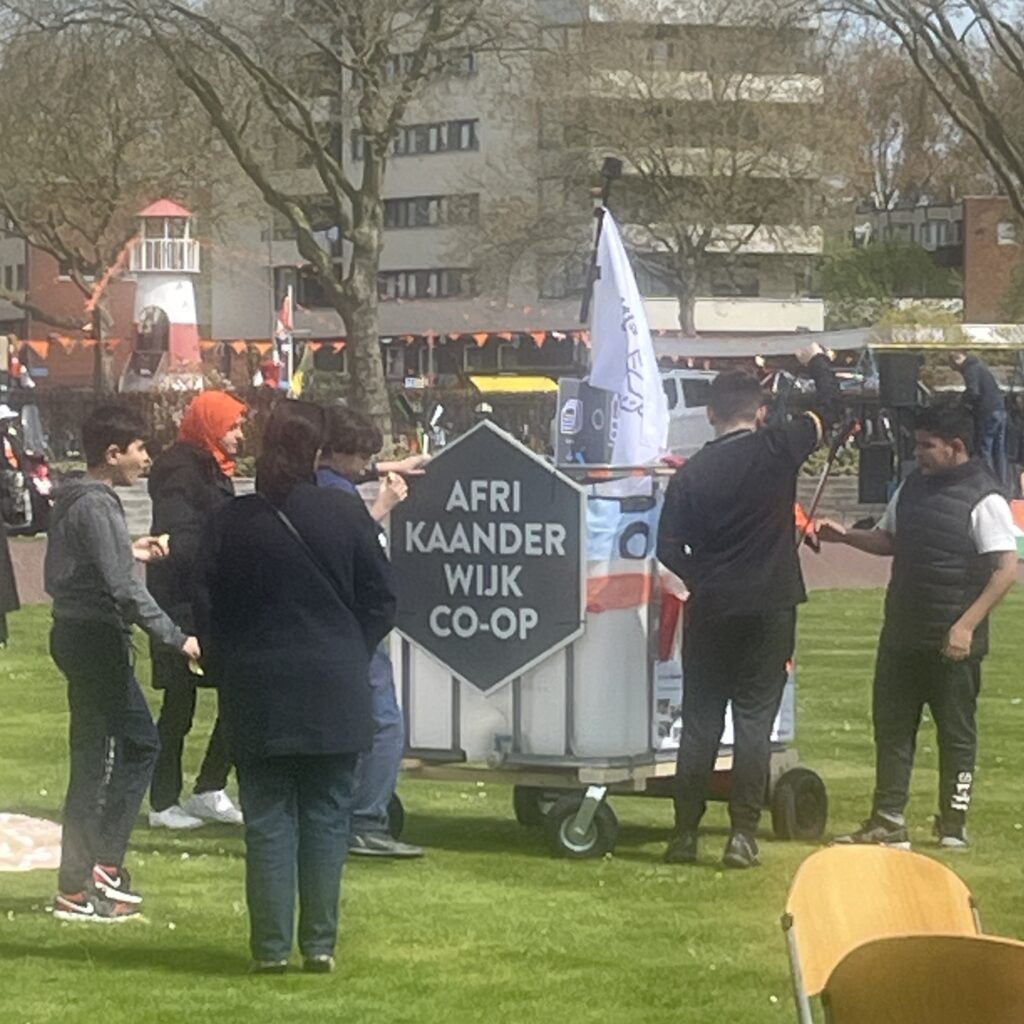
The main track was the co-design with a group of local residents of Afrikaanderwijk, coordinated via Afrikaander Wijkcooperatie. In total, 10 so-called thinktank sessions were organised, and the group developed the concept of the Inzamelbot based on the platform. The Inzamelbot is connected to the Grondstoffenstation (Resources Station), which deals with the recycling of resources in the local market. It will play a role in collecting valuable resources from the market.
A second function the Thinktank foresee is collecting and spreading neighbourhood stories. As a conversation starter, a carrier of these stories or other forms. This is something that needs to be detailed.
In total, more than 20 instalments of city things have been made in different projects, both by students in workshops and the think tank. An overview can be found on the dedicated website Wijkbot.nl. The platform is the perfect mix of a defined artefact and an open platform. There is still more to explore in developing the software, and we will fine-tune the workshop. New plans for educational programs are in the making.
At the “Miniconferentie” during the celebrations from 14:00-16:00, we will share our results, and a small exposition will tell more about the project.
During Dutch Design Week, on Thursday 26 October, the Wijkbot was the subject of a presentation, a workshop and a working session — a great opportunity to share experiences and make new contacts.
First, Tomasz Jaskiewicz gave a presentation at DRIVE about Digital Society, discussing the experiences and deployment of Wijkbot as part of Civic Prototype.
Afterwards we engaged with professionals from media, business and academia in a short workshop reflecting on different application areas.
In the afternoon, researchers and interested members of the public gathered to discuss Living Labs and practice-based research at the Network of Applied Design Research (NADR).
On 5 October, Wijkbot visited Hamburg at the invitation of the festival CityClimate meets CreativeCoding. We ran a workshop using the Wijkbots for Climate Change Awareness, with three teams building a Wijkbot focused on climate topics.
It was an inspiring session with excellent and creative participants who, in the three-hour workshop, formulated inspiring ideas, quickly prototyped them and presented them.
For this workshop we used for the first time a new standardised, robust version with a slightly longer wheelbase.
On 5 October, we will be at the conference and festival in Hamburg CityClimate meets CreativeCoding to host a workshop with the Wijkbot.
“Autonomous urban robots are starting to appear in European cities, with delivery-, scanning-, cleaning-, advertising-, security-, or waiter- robots being just some examples. The current development of most such robots is driven by commercial interests, with limited consideration for their impact on cities, communities, and ecosystems. In the Cities of Things Lab 010 (https://citiesofthings.nl), we take a different approach by treating urban robots as future co-citizens and advocating for their integration into democratic society and local civic communities.
We’ve created a low-cost kit (www.hoodbot.net) for co-prototyping neighbourhood robots with input from citizens. The resulting prototypes show how robots can become part of and contribute to local communities. We will prototype climate-focused neighbourhood bots for Hamburg’s streets in the workshop. We will explore the opportunities and risks posed by robotics developments in our cities, communities and ecosystems and investigate how such robots can become enablers of bottom-up systemic change.”
As part of the sneak preview of the Grondstoffenstation Afrikaanderwijk we will show two versions of Wijkbot, and specifically the iteration developed in the Cities of Things LAB010 project with the residents of the Afrikaanderwijk. That iteration is named Inzamelbot, as it is part of recirculating resources towards the Grondstoffenstation. Next to materials like paper, plastic, food leftovers, wood, and cans, we also invite residents and other visitors to leave their ideas for Wijkbot.
On the occasion of the sneak preview of the new Grondstoffenstation — designed by Superuse for the Afrikaanderwijk Cooperative — during the Tweeduizend Meter Maaltijd on 20 September.
We made two smaller versions of the Inzamelbot that navigate more easily in busy environments, ready for use at festivals and markets. The collection robots clearly share a family resemblance with the Grondstoffenstation.
The Grondstoffenstation collects reusable materials: paper, plastic, wood, organic waste and cans. Special tubes were made for the cans, and there is also a built-in option to make a donation.